AI & App development
2026
MumbleJumble — Speech Disfluency Model
A model that turns disfluent speech into text people can actually read. Dummy deck — replace with the real one-liner.
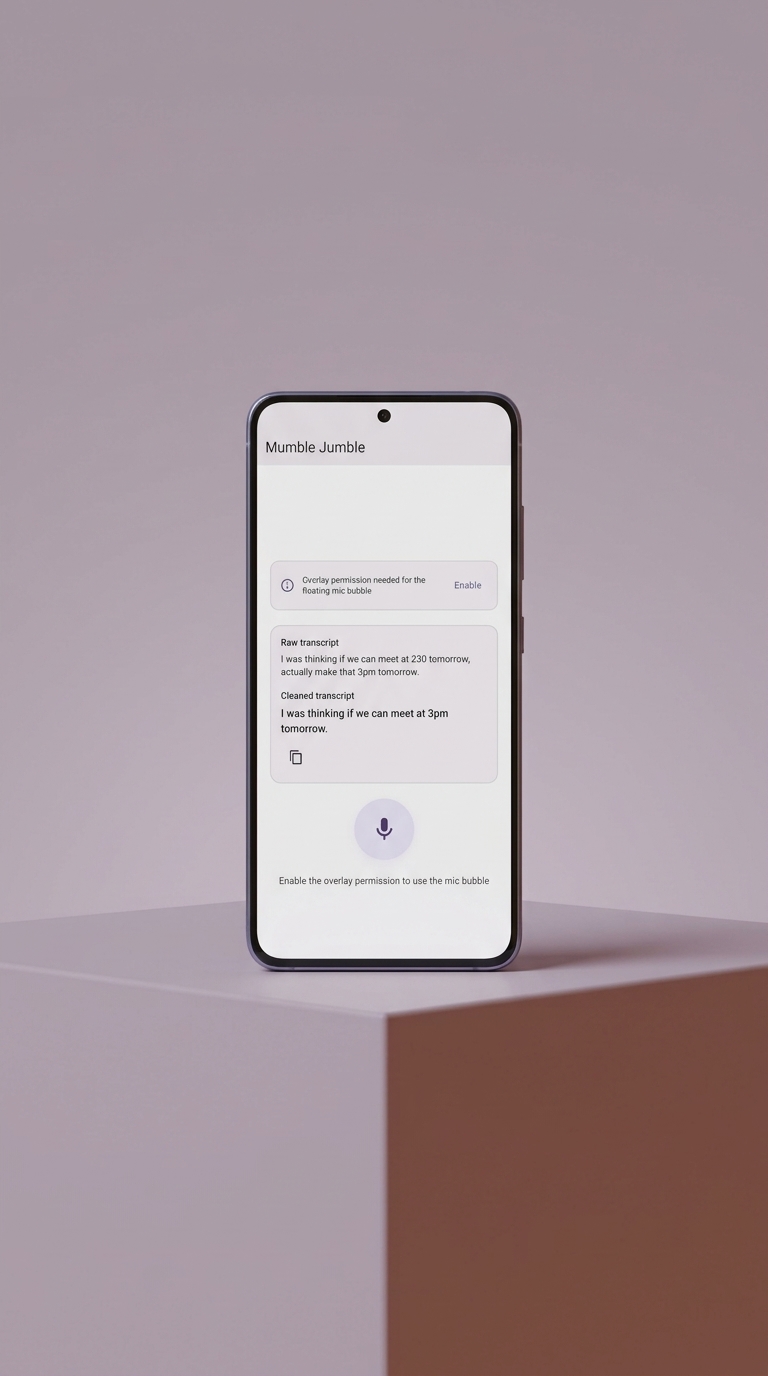
Speech-to-text has become very good at clean audio and very bad at real speech. Filler words, false starts, repeated syllables and mid-sentence corrections are exactly the parts a transcription is supposed to clean up, and exactly the parts most models preserve verbatim.
MumbleDejumble started as a final year project with a narrow question: can a small model learn to remove disfluencies without rewriting what the speaker meant? The distinction matters — deleting an 'um' is cosmetic, deleting a self-correction changes the sentence.
The problem
Existing cleanup tools either leave everything in or paraphrase aggressively. For a student with a stammer, or anyone giving a recorded lecture, neither is useful. The output needs to read like the speaker at their most fluent, with their words and their structure intact.
Approach
The pipeline transcribes first, then edits. Whisper handles the audio; a smaller sequence-to-sequence model is fine-tuned on pairs of disfluent and cleaned transcripts. Keeping the two stages separate means the editor can be evaluated on its own, and swapped out later without touching the audio layer.
- Synthetic training pairs built by injecting fillers and false starts into clean text.
- A tagging pass that marks each token as keep, drop or uncertain before editing.
- A hard rule against removing content words, enforced at decoding time.
- A review screen so the speaker can accept or revert any change.
The build
The demo app is deliberately unglamorous: record, wait, read, edit. Most of the engineering went into latency — chunking long recordings so a ten-minute talk does not sit behind a spinner, and caching transcript segments so a correction does not reprocess the whole file.
The most useful feature came out of testing: a confidence marker on every edit. When the model is unsure whether a phrase is a filler or a genuine restart, it leaves the text alone and flags it. Users trust the tool more when it admits what it does not know.
Outcome
- Placeholder — disfluencies removed
- —
- Placeholder — meaning preserved
- —
- Placeholder — human preference wins
- —
Dummy closing paragraph — replace with the real evaluation results and a short reflection on what you would research next.